
Drip Edge and Gutters: Which Goes Behind the Other?
8 min read
What a drip edge is, whether the gutter goes behind it or under it, and why the pair matters for your fascia, including metal roofs and mobile homes.
Based in Spring Hill, we work across Hernando, Pasco, Citrus and Sumter counties. Free on-site quote within 24 to 72 hours. Get a free quote
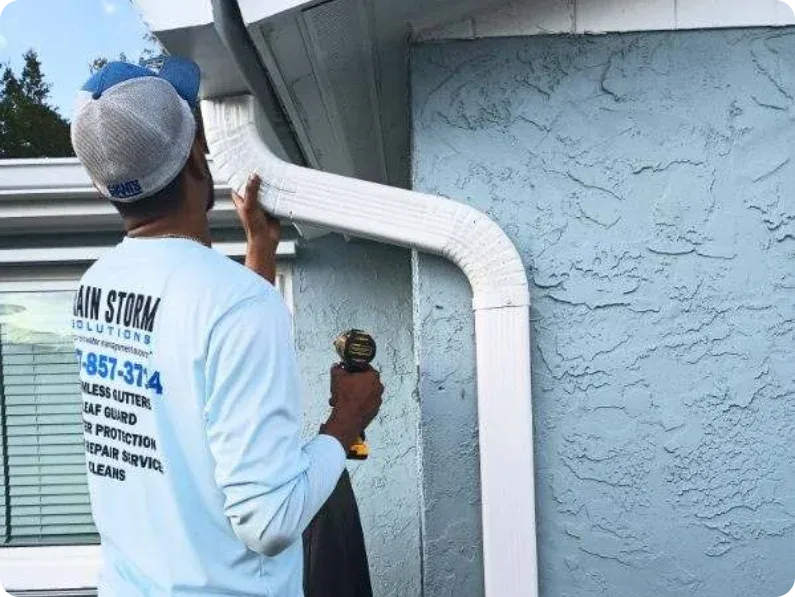
Look along the bottom edge of your roof. Just above the gutter there is a thin strip of metal with a bent lip. That is the drip edge. It is easy to miss, and it decides whether rain lands in your gutter or runs down the back of it onto the wood.
The question we hear is simple: does the gutter go behind the drip edge, or under it? The answer is a little of both, and the details protect your fascia, the board your gutter hangs from. Here is what the drip edge is, how the two parts fit, and what goes wrong when they do not.
What a Drip Edge Is
This Old House describes drip edge as “a type of metal flashing installed along the edges of a roof to direct water away from the roof structure and into the gutters” (This Old House). It protects the fascia and the roof deck, and it gives water a clean place to leave the roof.
The test that article ran makes the point. On a shed built without drip edge, the sheathing under the shingles “had turned black from moisture damage.” Water had worked its way back under the roof edge, with nothing to stop it.
Drip edge is a roofing part. Your roofer sets it when the roof goes on, and it stays with the roof. The gutter crew has to work around what is already there, which is why the two jobs are linked.
Where It Sits on the Roof
A roof has two kinds of edge. The eaves are the low edges where the gutter hangs. The rakes are the sloped edges at the ends of the roof. A gutter only goes on the eaves, so the eave edge is the one that matters here.
Roofers do not all stack the layers the same way, and the sources we read show it.
This Old House’s install guide puts the drip edge “under the felt at the eaves” and over it at the rakes. The idea is that water running down the underlayment lands on the metal and drops off the edge (This Old House).
The FORTIFIED program, which sets storm-resistance standards for roofs, takes a different approach to the eave. Its enhanced edge detail puts the drip edge over the underlayment, with a fully adhered starter strip over the drip edge, so the edge is sealed and tied together for high wind. FORTIFIED says IBHS testing shows this method “provides optimum performance of shingle roof covers at the edges, where roof pressures are highest” (FORTIFIED technical bulletin FH 2023-09).
Neither is wrong. They answer different questions: a standard roof, and a roof built for hurricane wind. What matters to the gutter is that the metal lip ends up hanging over the gutter, as the next section shows.
Water running behind your gutter, or fascia that feels soft? Call (727) 857-3714 or get a free estimate. Chris will look at the roof edge and how the gutter hangs before anyone quotes a thing.
So Does the Gutter Go Behind It or Under It?
Picture it from the side, looking at the end of the eave. The fascia board is the vertical face. The gutter hangs on it, in front of the board, held by hangers that screw into the fascia. The roof edge sits above and behind.
The right fit has the drip edge reaching out over the gutter. Family Handyman’s roofing advice puts it in one line: “Make sure the drip edge is extended past the fascia and into your gutters” (Family Handyman). Water comes down the shingles, rides the metal lip, and drops into the trough.
So the gutter sits below the drip edge’s lip, on the fascia, with the metal reaching out over it. Two things must be true:
- The lip reaches the gutter. If the drip edge stops short, water can miss the trough.
- The gutter is hung high enough to meet the lip. A gutter hung too low or too far out is the one water runs behind.
This Old House adds a detail: it says the drip edge should be set with a 3/8 to 1/2 inch gap from the fascia. Install it tight, the article says, and it “creates a path for water to cling to the fascia,” which runs down the board and shortens the fascia’s life (This Old House).
What Goes Wrong: Water Behind the Gutter
The most common failure is simple. The gutter is hung too low or too far out, the drip edge does not reach it, and water runs behind the trough.
Family Handyman’s repair guide says water behind a gutter usually happens when it “was installed without any flashing over the back of the gutter.” The fix it describes is a gutter apron, a bent piece of flashing that tucks under the shingles and over the gutter, fastened with sheet-metal screws. For a gutter that sits below the drip edge, it suggests rolled flashing tucked “up under the drip edge and over the top of the gutter” (Family Handyman). It also says to match the metal: aluminum flashing with aluminum gutters, because galvanized steel corrodes aluminum.
You will not see this from the ground, because the water runs behind the trough. Signs you can see:
- Dark streaks or peeling paint on the fascia behind the gutter.
- Water stains on the soffit under the eave.
- A gutter that has started to pull away from the board. Our page on fascia rot from gutters shows how this plays out.
Why It Matters for the Fascia
The fascia is a board. Wood that stays wet rots. A gutter that overflows or sends water behind itself keeps that board damp for days after every storm.
That is bad for two reasons. The board looks bad, and a soft board cannot hold a gutter. If the wood the hangers screw into has gone soft, the screws pull out and the gutter sags or falls. Our guide to stopping gutter leaks covers the other leak sources, such as seams and corners.
Fixing rot is a carpentry and roofing job, and we will tell you what we see at the estimate. What you can do first is look. Run a screwdriver gently against the back edge of the fascia where it is exposed. If it sinks in, you have a bigger problem than a drip.
Metal Roofs and Mobile Homes
Metal roofs add a twist. The panels expand and contract with the heat, so a gutter fastened hard to the panels gets stressed every day. Our post on gutters for metal roofs in Florida explains why the gutter belongs on the fascia, not on the panels.
On a mobile home with a metal roof, our standard is to attach the gutter behind the drip edge where it applies. That keeps the water running off the roof and into the gutter instead of behind it. The gutter style on a mobile home is usually a roll form or pan gutter. See gutters for mobile and manufactured homes and our guide on whether mobile homes need gutters.
Storm-Rated Roofs and Existing Gutters
If your roof was redone to the FORTIFIED standard, the drip edge is part of a sealed edge, and anything that cuts into it can cost you the designation. The bulletin says that when gutters stay in place during a re-roof, a roof can still qualify for the “New Roof” designation if new drip edge is installed over the existing gutters in line with the edge detail. It also notes that leaf guards installed by “insertion under the shingle or starter strip” interrupt the edge. If you plan to add guards, read our post on whether gutter guards void a roof warranty. Atlas Roofing’s bulletin lists removing the drip edge as a method to avoid with gutter covers (Atlas bulletin).
A Quick Look From the Ground
You can check most of this without a ladder. Stand back from the house after a rain and look along the roof edge.
- Can you see the metal lip, and does it reach out over the gutter?
- Are there dark streaks on the fascia or the soffit under the eave?
- Does water pour off the roof edge and into the gutter, or drip down behind it?
- Is the gutter level and tight to the board, or sagging away from it?
If something looks off, take a photo. It helps whoever looks at it next. One note on those snow-country sources: the membrane tip from This Old House is aimed at ice dams, which are not a Florida problem. The drip edge advice is the part that carries over.
What to Ask Before the Work
If you are having a roof and gutters done in the same season, put these questions to both crews.
- Is there drip edge on the eaves? Some roofs have none.
- Does it reach into the gutter? The lip should end over the trough.
- Is there flashing over the back of the gutter? A gutter apron closes the gap on a roof that was built without enough lip.
- Who sets the gutter height? Ask that the roofer and gutter installer agree on it before either starts.
- What is behind the gutter? Look at the fascia while the gutter is off.
We install seamless aluminum gutters across Hernando, Pasco and Citrus counties, and the free estimate starts with the roof edge. See our gutter installation page for how the job works, or call (727) 857-3714 or get a free estimate.
Want Chris to look at your home? Free on-site quote within 24 to 72 hours. Call (727) 857-3714 Get a Free Quote
Thinking about new gutters?
Free on-site quote within 24 to 72 hours.
Florida Certified Specialty Contractor, license SCC131154760