
Home Depot Gutter Guards vs a Pro Install in Florida
9 min read
Standing in the aisle with a box of DIY gutter guards? How the common types work, what pine needles do to them, and what the ladder asks of you.
Based in Spring Hill, we work across Hernando, Pasco, Citrus and Sumter counties. Free on-site quote within 24 to 72 hours. Get a free quote
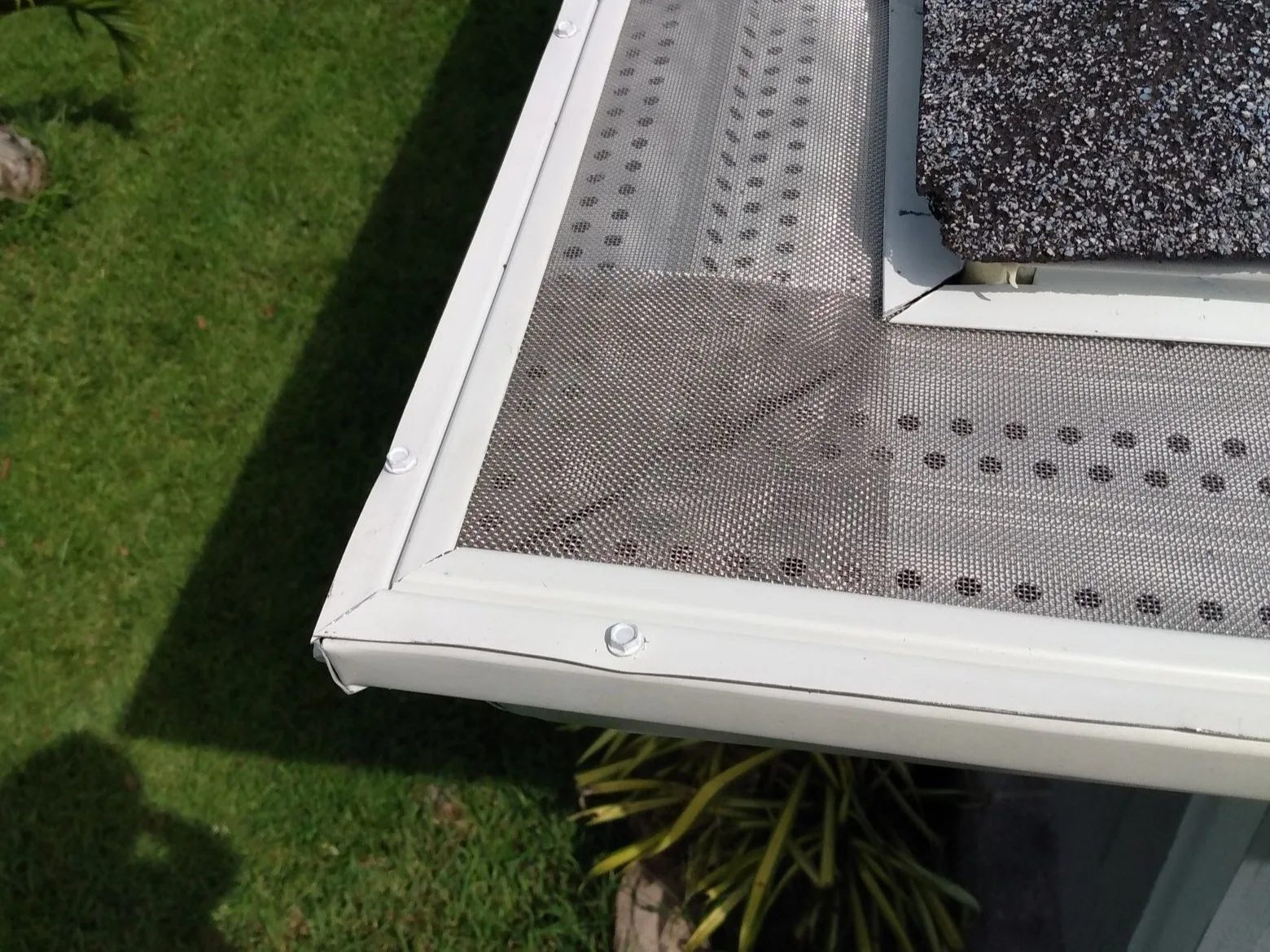
You are in the aisle, looking at Home Depot gutter guards, or at another box of DIY gutter guards, and a price that looks a lot lower than a quote. The question is fair. Will it work under slash pines, and do you want to be on a ladder doing it?
This guide does not tell you what any of it costs. For prices, read our gutter guard cost guide. It covers the types of guards sold for DIY, what pine needles do to each one, what the ladder asks of you, and what a professional install includes at Rain Storm Solutions. Then you can decide with the facts in front of you.
Home Depot Gutter Guards and Other DIY Types: How They Work
Guards made for do-it-yourself installs fall into a few families. This Old House’s guide to DIY gutter guards walks through them, and what follows leans on it. We are describing how each type works, not rating any store or brand.
Screen. The page says “Screen gutter guards are perforated with large holes that keep out bigger debris, such as mature leaves.” Installation can mean “lifting the bottom row of roof shingles and sliding the edge of the screen underneath it.” A screen sits over the gutter like a lid with holes in it.
Foam. Foam guards “have sponge-like inserts that fill your gutters.” The same guide explains that “Water passes through the porous material, while leaves and debris stay on top.” The channel is filled, so the water has to soak through the foam to reach the bottom.
Brush. “Brush gutter guards have a thick wire with plastic bristles that resemble pipe cleaners.” They “rest in your gutter trough,” so there is nothing to screw to the roof or fascia. The guide notes they are “easy to install as long as you feel safe on a ladder.”
Snap-in and mesh. Snap-in guards “use tension instead of screws to stay in place.” The guide says they “often slide under the first course of roof shingles and snap onto the outer lip of your rain gutter.” Micro-mesh is a finer version of a mesh guard, with much smaller openings than a plain screen.
Each type trades something. A guard with big openings lets water in fast and also lets small debris in. A guard with tiny openings keeps small debris out but has to be made so water still gets through in a downpour. Which trade is right for your house depends on what falls on your roof.
What Pine Needles and Oak Debris Do to Each Type
In Spring Hill, what falls on the roof is slash pine needles and laurel oak debris. Our Spring Hill page covers it: the slash pine and laurel oak that shade most yards there drop needles and catkins all year. Needles are thin and long. Oak leaves are wide and flat, and oak catkins drop too. A guard has to handle both.
Here is what published testing says, one type at a time.
Screen. This Old House says its tested screen “blocked most debris except for pine needles, seedpods, and shingle grit.” It also says “metal screen guards were among the most durable products on the market.” So screen holds up physically, but the openings are the issue with needles. In its separate piece on guards for pine needles, the advice is blunt: “You should avoid reverse-curve, brush, screen, and standard mesh guards when trying to stop pine needles.”
Foam. “Foam gutter guards can stop pine needles, but generally aren’t worth investing in,” says that pine needle guide, which adds that foam is hard to install and breaks down in sunlight. The DIY guide lists the same drawback: “they can break down over time.” In Florida, the sun is a real part of that.
Brush. The pine needle guide says “These bristles don’t create a fine barrier and have gaps large enough for pine needles to slip right through.” The DIY guide adds that brush guards “won’t stop small debris and tend to catch the buildup of large debris in their bristles.” Brush guards are better matched to a yard with big leaves than to a yard with pines.
Snap-in. The DIY guide says add-on caps, which also slip under the shingles and clip onto the gutter, have slits that “can trap pine needles.” A needle can catch in the slit instead of washing off.
Micro-mesh. For comparison, the pine needle guide says “Micro-mesh systems were the best type of guard we tested for keeping pine needles out of gutters.” The DIY guide agrees that with micro-mesh “debris as small as pine needles, pollen, or shingle grit can’t pass through,” and calls micro-mesh good “for homeowners living under a tree canopy.”
Notice what those quotes do not say. They do not say every DIY guard fails. They say the type matters a great deal under pines, and that the finest mesh did best in their tests. Read the label and the install instructions for the exact guard in your hand.
Is the Ladder Work Safe for You?
This is the part to weigh most. Putting a guard on means being at the edge of the roof, at gutter height, for the whole length of the house.
This Old House does not hide it: “ladder work is dangerous, and gutter guard installations don’t happen in a controlled environment.” Its advice is: “To reduce fall risks, we recommend leaving anything beyond a single-story job to the pros.” It also says it highly recommends a roof harness.
The CDC’s National Institute for Occupational Safety and Health has a ladder safety page. Three lines from it matter here. “Many ladder injuries happen at home.” It says to “Set up extension ladders at about a 75-degree angle.” And it lists “Overreaching while on the ladder” as improper use. Overreaching is the very thing that happens on a gutter job, when one more foot of guard is just out of reach and moving the ladder feels like a chore. NIOSH also notes that “Small companies and individual ladder users do not typically receive the training for safe use of portable ladders.”
There is a second risk on the roof side. The DIY guide warns: “Don’t lift or damage shingles during installation, as this can cause leaks and might void your roof warranty.” Several guard types slide under the first row of shingles, so a careless tug can cost you more than the guard did.
None of this means you should never do it. It means ask yourself honestly: are you steady on a ladder, do you have a helper to foot it, and are you comfortable moving it a dozen times along the house?
What a Pro Install Includes at Rain Storm
Rain Storm Solutions installs two guards, and only two: ONE Gutter Guard and Lock N Mesh. We do not mix and match other brands.
The pine rule decides the guard. If your home has pine trees, we cannot offer Lock N Mesh, so we fit ONE Gutter Guard. If it has no pines, you can choose between the two. Roof type also plays a part, and Chris goes through the options with you at the estimate. We compare them in ONE Gutter Guard or Lock N Mesh.
Guards go on gutters you already have. Asked how often they put guards on existing gutters, the owners said “Quite often, especially on the 5-inch gutters.” They also say ONE Gutter Guard “is designed for both 5-inch and 6-inch gutters or bigger when needed.” If your gutters are sagging or pulling away, that gets looked at first. Our guide to putting guards on the gutters you already have shows what to check.
The warranty is tied to how it is installed. The ONE Gutter Guard maker’s warranty page describes a “20-YEAR PERFORMANCE WARRANTY” and says it applies “if installed to our factory specifications.” It also says the warranty is to be honored if the guard is “installed to the manufacturer’s specifications.” That is worth knowing before you buy any guard, DIY or not: read how the warranty ties to the install. On the ONE Gutter Guards we install, that is the 20-year performance warranty. Lock N Mesh carries a lifetime material defects warranty.
You get the work done and the ladder stays in the truck. The crew handles the climbing, the measuring and the fit. The free estimate is in person: Chris measures, sketches the house, and leaves the estimate on the spot. It is good for 30 days.
What No Guard Does, DIY or Pro
Here is the part worth knowing before you buy any guard. No guard, DIY or pro, means you never go back up.
“Maintenance-free gutter guards is a myth,” say Rain Storm’s owners, and they go over it with each customer at the estimate. A rare rinse is accurate. Most of the upkeep is where a splash shield sits. That holds for any guard, from a foam insert to a micro-mesh. A guard cuts the work down a lot. It does not remove it. Our post on whether gutter guards need maintenance lays out what to expect.
So if a DIY package promises you will never touch the gutters again, treat that as a red flag about the claim, not about the store. The honest comparison is how often, and how hard, the upkeep will be on your house.
How to Decide
Start with the trees. Pines overhead point you to the finest mesh, and the quotes above are why. Oaks and big leaves only are a lighter job, and an open screen has a better shot.
Then look at the house. One story with low gutters and a clear lawn for a ladder is the easiest case for doing it yourself, though This Old House’s own advice is to leave anything taller to a pro. Two stories, a steep roof, a pool cage in the way, or a roof still under warranty make a pro install easier to justify.
Then think about the warranty. Ask any maker how their warranty treats a DIY install before you buy, and keep the paperwork.
Finally, think about a second trip. Foam that breaks down in the sun, or a screen that needles pass through, means a second purchase and a second day on the ladder. That is the real cost to weigh against the price on the box, and you can see the price side in our cost guide.
If you would rather hand it off, see our gutter guards service page. If you live in Spring Hill, Brooksville, Hudson or the towns around them, call (727) 857-3714 or ask for a free in-person estimate. Chris will look at your trees, your gutters and your roof and tell you which guard fits.
Want Chris to look at your home? Free on-site quote within 24 to 72 hours. Call (727) 857-3714 Get a Free Quote
Want leaves out of your gutters?
Free on-site quote within 24 to 72 hours.
Florida Certified Specialty Contractor, license SCC131154760