
K-Style vs Half-Round Gutters: Which Fits a Florida Home?
8 min read
What K-style and half-round gutters are, how much water each carries, how they hang, what they cost compared to each other, and which suits a Florida home.
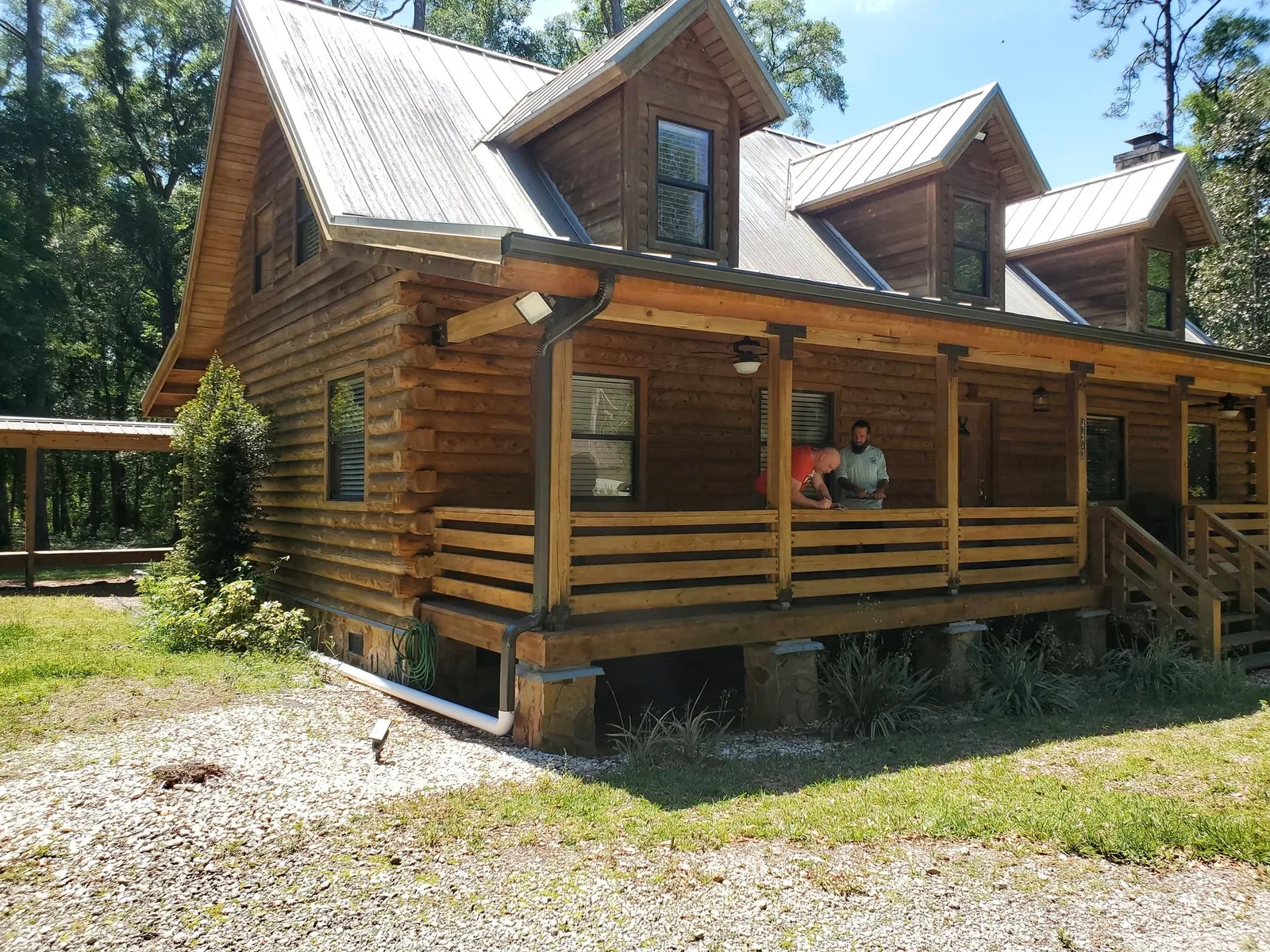
There are two gutter shapes most homeowners run into: K-style and half-round. K-style is by far the more common of the two. Half-round shows up now and then, usually on an older or more traditional house, and often in copper.
This guide explains what each shape is, how much water each one carries, how they hang, what they cost compared to each other, and which one makes sense for a Florida home. We will also be straight about our own part in it: we install K-style seamless aluminum gutters, and we do not install half-round. If half-round is what your house calls for, this guide will still help you know what to ask for.
What the Two Shapes Are
K-style is named for its shape, not for a word. This Old House puts it simply: the “K” in K-style “doesn’t stand for anything.” It describes the cross-section, the shape you see if you cut the gutter in half (This Old House). Englert, a gutter maker, describes it as a profile with “a flat back and bottom with a decorative front that resembles crown molding” (Englert).
That flat back is the key detail. It sits flat against the fascia, the board along the roof edge, so the gutter can fasten straight to the house.
Half-round is what it sounds like: a gutter shaped like a pipe cut in half lengthwise, open at the top. It has no flat back, so it hangs from brackets or straps instead of sitting against the fascia.
Which is more common? K-style, by a long way. This Old House calls it “the most common gutter type in North America,” and the Jaspector inspection wiki says K-style gutters “dominate modern residential work” (Jaspector).
Which One Carries More Water
This is where the two shapes differ most, and it is the part that matters most here.
This Old House says “K-style gutters handle more than twice the water volume of comparably sized half-round gutters.” Englert says the flat profile lets K-style “hold more water than traditional rounded options.” The reason is the shape: with a flat bottom and a tall front, a K-style gutter holds water across its whole width, while a half-round is deepest only in the middle.
Sources do not agree on the exact gap. Published sizing tables use different rain rates and give different numbers. But every source we read puts K-style ahead for the same width, and none puts half-round ahead. Jaspector’s advice is fair to both: half-round is not a worse gutter, but it “may need careful sizing to match the runoff demands of a large or steep roof.”
Why does that matter so much in Florida? Because of how rain falls here. When Tropical Storm Debby passed in August 2024, Bay News 9 recorded 6.77 inches in Spring Hill, 6.44 inches in New Port Richey and 6.99 inches in Crystal River (Bay News 9). A gutter that keeps up with a gentle rain can overflow in a storm like that. Capacity is not a detail here. It is the whole job.
Size matters as much as shape. Englert says a 6-inch K-style gutter “can handle about 40% more water” than a 5-inch one. It also calls 5-inch “the most common size for residential properties,” but the most common size is not always the right one for a Florida roof in a summer storm. Our gutter size guide walks through how to match the gutter to your roof.
Not sure your gutters can keep up with a summer storm? Call (727) 857-3714 or get a free estimate. Chris looks at the roof, not just the gutter, before he recommends anything.
How Each One Hangs
K-style fastens directly to the fascia. This Old House notes that its flat back “allows for secure attachment to the fascia board,” and Jaspector says K-style installs with hidden hangers. A hidden hanger sits inside the gutter, where you do not see it from the yard, and screws through the back of the gutter into the fascia. On our jobs, those screws are stainless with color-coded heads, so they match the gutter. And on a house with no fascia board, Englert says K-style can still go up, on strap hangers fastened from the roof.
Half-round hangs differently. Jaspector says it uses “external brackets, straps, or decorative hangers depending on the material and architectural style.” On a traditional house, those brackets are part of the look. They are also more parts to buy and install.
One thing both styles need is a solid roof edge. A gutter is only as strong as the wood it hangs on. If the fascia behind your old gutters is soft, it needs fixing before new gutters go up, whichever shape you choose.
Cost: Which Is Cheaper?
K-style, in general. Jaspector says K-style usually has the lower initial price and wider availability, and that half-round usually costs more because of its profile, its brackets, and the kinds of homes it tends to go on. This Old House says half-round gutters “may have higher gutter installation costs because of specialized hangers and downspouts.”
Material matters too. Half-round is “frequently seen in copper and steel, though aluminum versions exist as well,” according to Jaspector. Copper costs more than aluminum, so a half-round quote is often a copper quote, and that is a big part of the gap.
Jaspector’s last tip is worth following no matter which style you pick: compare whole systems, not just the gutter price. Downspouts, hangers and finishes can change the total.
Cleaning and Upkeep
Here, half-round has a real edge. This Old House says “the curved sidewalls of half-round gutters allow them to drain more thoroughly than K-style.” It also warns that K-style gutters “may retain standing water that can accelerate corrosion or promote mosquito breeding” if they are not kept up.
In Florida, standing water and mosquitoes are not a small point. The fix for K-style is the same as for any gutter: the right slope toward the downspouts, enough downspouts, and keeping leaves out. Under Florida oaks and pines, that last part is where gutter guards come in. Guards go on K-style gutters, including gutters you already have. Our guide to the best gutter guards for Florida compares the options, and our post on whether gutter guards need maintenance is honest about what they do and do not do.
When Half-Round Makes Sense
Half-round is a good gutter on the right house. Jaspector ties it to older homes, masonry facades, slate roofs and higher-end traditional detailing, and notes that historic districts “may also influence profile choice because visible exterior details may be reviewed for compatibility.”
If you own a historic home where the original gutters were half-round, or your neighborhood’s rules call for it, half-round may be the right answer. In that case, look for a company that specializes in it, ask what metal they use, and ask how they sized it for your roof, given the capacity point above.
For most homes with a fascia board along the roof edge, though, K-style is the natural fit. If you live in a deed-restricted community and the HOA cares about the look, the question is often color more than shape. Our guide to gutter colors and HOA approval covers that.
Are Seamless Gutters K-Style?
Usually, yes. “Seamless” describes how the gutter is made, and “K-style” describes its shape. A seamless gutter is formed on site from a coil of aluminum, run through a machine that shapes it and cuts it to the exact length of each wall, so a long run has no joints along the way. K-style is the shape we run.
That is what we install: seamless K-style aluminum, formed on site, .027 aluminum, in 23 stock colors with 27 more as special orders. Our post on seamless versus sectional gutters explains why fewer joints means fewer leaks, and our seamless gutter page shows how we put them up.
Mobile homes are the exception. They generally take a roll form or pan gutter, not a K-style one. Our post on whether mobile homes need gutters explains why.
The Short Version
| K-style | Half-round | |
|---|---|---|
| Shape | Flat back and bottom, decorative front | Half a pipe, open at the top |
| Water it carries | More, for the same width | Less, so size it with care |
| How it hangs | Fastens to the fascia, hidden hangers | Brackets or straps |
| Usual metals | Aluminum, most often | Often copper or steel |
| Cost | Usually lower | Usually higher |
| Draining | Can hold some standing water | Drains more thoroughly |
| Best fit | Most Florida homes with a fascia board | Older, historic or traditional homes |
We install seamless K-style gutters across Hernando, Pasco and Citrus counties, with our own crew and a 20 year installation warranty that covers leaks and faulty installation. Call (727) 857-3714 or get a free estimate, and Chris will look at your roof and tell you what it needs.
Want Chris to look at your home? Free on-site quote within 24 to 72 hours. Call (727) 857-3714 Get a Free Quote
Have Chris look at your home
Free on-site quote within 24 to 72 hours.
Florida Certified Specialty Contractor, license SCC131154760