
How Much Slope Should a Gutter Have?
8 min read
Sources give 1/8 to 1/2 inch of drop per 10 feet. Here is what slope does, why standing water is not always a slope problem, and how to check your own gutters.
Based in Spring Hill, we work across Hernando, Pasco, Citrus and Sumter counties. Free on-site quote within 24 to 72 hours. Get a free quote
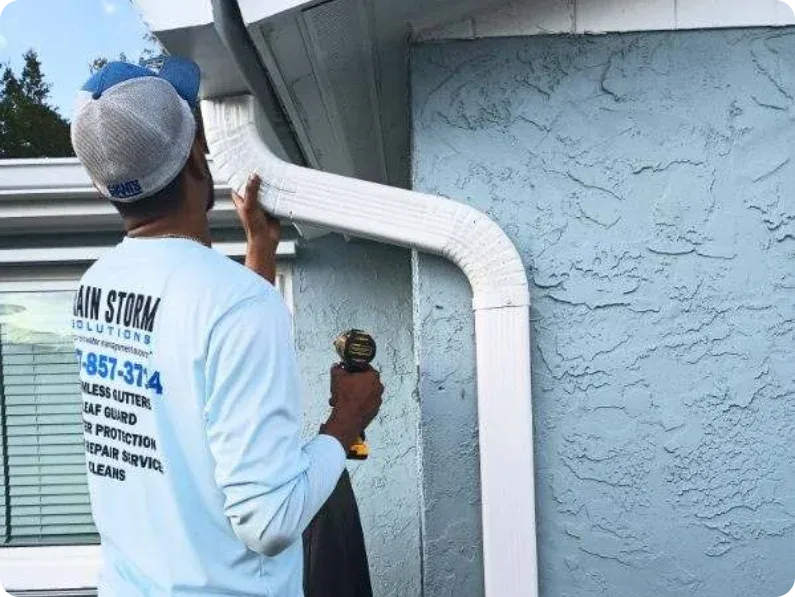
You walk outside after a storm and look up. The gutter along the front of the house has a strip of water sitting in it. The rain stopped an hour ago. Is that normal, or is the gutter hung wrong?
The honest answer is that it depends on how much water, for how long, and where. A gutter does not need to be bone dry the minute the rain ends. But a gutter that holds water for days is telling you something, and the cause is not always the slope. This guide covers the slope numbers that published sources give, what else leaves water behind, and how to check your own gutters from the ground.
How Much Slope a Gutter Needs
A gutter is hung with a slight tilt so that water runs toward the downspout instead of sitting in the middle. The tilt is small. You will not see it from the driveway.
Sources give a range. LeafGuard recommends “1/8 to 1/4 inch for every ten feet of gutter length.” This Old House says standard gutters are “typically sloped about 1/4 inch for every 10 feet.” An installation checklist from Gutterworks calls for “A 1” to 2” slope” over a 40-foot run, which works out to 1/4 to 1/2 inch per 10 feet.
Put those side by side and the working range is about 1/8 inch at the gentle end to 1/2 inch at the steep end, with 1/4 inch per 10 feet the figure you will see most. Here is what that looks like in practice.
On a 20-foot run at 1/4 inch per 10 feet, the high end sits half an inch above the low end. On a 40-foot run, the drop is a full inch. That is the whole story. A half inch of drop spread over 20 feet is very little tilt.
More Slope Is Not Better
It is tempting to think a steeper gutter must drain faster and therefore be safer. The same Gutterworks checklist warns against it: “Too much slope does not look good and you lose some of the gutters holding capacity.” Its advice is to “strike a happy medium.”
The reason is geometry. A gutter hangs under the roof edge, and the front lip has to stay lower than the back so water spills forward, not behind. When the run tilts a lot, the high end of the gutter sits close to the shingles while the low end drops away, and on a long run the difference shows. This Old House makes the same point about longer runs: a steeper pitch becomes more noticeable, so the installer has to balance performance with appearance.
What Else Leaves Water in a Gutter
Here is the part that surprises people. Slope is not the only reason a gutter holds water, and it may not be the main one.
In a Green Building Advisor forum thread about gutter pitch, editor Malcolm Taylor notes that standing water usually comes from debris, and that it affects sloped and flat gutters similarly. That fits the trees around Spring Hill. Slash pine needles and live oak leaves and catkins mat together in the channel, and a mat holds water like a sponge. The gutter can be hung perfectly and still look wet three days after the last storm.
Four common causes, in the order we would check them:
- Debris. A layer of needles, catkins or roof grit in the bottom of the channel. Water sits in it and drains slowly.
- A blocked downspout. If the water cannot leave at the outlet, it backs up along the run. Our page on a clogged downspout covers this one.
- A sag between hangers. A low spot where the gutter has bent or a hanger has failed. Water collects there no matter how the run was pitched. This is the cause behind most of what we describe on our sagging gutters page, and This Old House lists improper hanger spacing and missing slope among the installation causes.
- A flat or reversed section. A stretch hung level, or tilted away from the downspout, usually where two pieces were joined or a corner was added.
When LeafGuard says that if your gutters are “holding water,” the slope may be wrong, that is a reasonable first guess. It is a guess, though. Clear the debris first. If the water is still there the next day, look harder at the slope.
Why Downspout Placement Changes Everything
Slope only works if the water has somewhere to go. That means the number and position of downspouts matters as much as the tilt.
This Old House says gutters 60 feet or longer should have “at least two outlets,” and that where there are two, the gutter should be pitched “so water flows toward both downspouts.” It also says that adding downspouts is often more effective than making the gutter bigger. The longer a run, the more drop you need to reach a single outlet, and the more steeply it has to tilt, which brings back the problem of too much slope on a long run.
So a long, shallow slope toward one far corner is a design choice with a cost. Two outlets, with the high point in the middle, shortens each leg and lets the pitch stay gentle. Chris measures and sketches the house at the free estimate, so that is a good time to ask where the downspouts will go. Our guide on what size gutters you need in Florida shows how roof area and downspout count tie together.
Does a Little Standing Water Matter?
A shallow puddle that drains by the next day is not a crisis. The trouble starts when it stays, for three reasons.
The first is weight. This Old House says, “Most gutters sag because trapped water and debris are weighing them down.” Water is heavy, and a long run holding a few inches of it asks a lot of the hangers. A sag then makes a deeper low spot, which holds more water, and the cycle feeds itself.
The second is the wood. Water that has nowhere to go eventually finds the back of the gutter, and wood that stays wet rots. Our page on fascia rot from gutters walks through how that happens.
The third is the mat itself. A gutter that holds wet debris keeps the debris wet, and wet needles and catkins break down into a sludge that holds still more water. If that sounds like your gutters, the cause is the debris, not the slope, and a fresh tilt will not fix it. We cover the guard side of that in do gutter guards need maintenance.
None of this means you need to chase every drop. It means a gutter that is still wet a day or two after the rain deserves a look, and one that is bone dry within hours is doing its job.
What Florida Rain Does to This
Florida adds a twist. The National Weather Service in Tampa Bay says the rainy season for the rest of West Central Florida runs from May 25 to October 10, with warm, humid conditions and frequent showers and thunderstorms. For Spring Hill and the rest of Hernando and Pasco County, that is most of the summer and early fall.
Frequent rain means a gutter rarely gets a long dry stretch to dry out. A film of water that you see after a morning storm may be there again by evening. So judging a gutter by a single glance after rain is not a fair test.
A better test is to look a day or two after a rain, once the roof has stopped dripping. Water standing in the channel then points to a debris mat, a low spot or a bad slope. A damp film at the bottom that dries out is normal. Standing water that sits for days is worth a closer look, because a gutter full of wet debris is heavy, and weight is what bends a gutter and pulls hangers out of the wood.
How to Check Your Own Gutters
You can do this with a hose, a step ladder and a few minutes.
Run a hose at the high end of a run and watch where the water goes. It should travel toward the downspout and leave. If it pools and stops, note where. Then check from the ground: stand back, look along the gutter, and see if the front edge dips between hangers. A dip that lines up with where the water pooled is a sag.
For a more exact read, use a string and a small level. Hold the string along the bottom of the gutter, then compare the height at each end. For a 20-foot run at 1/4 inch per 10 feet, you expect about half an inch of drop toward the downspout. If the run is level or tilts away, you have found the problem. If you are not comfortable on a ladder, do not use one. Look from the ground and ask a professional.
If you want an installer to read it for you, that is part of a free estimate. Chris measures and sketches the house in person, so ask him about slope and downspout placement while he is there. See our gutter installation page for how the work goes, or the seamless gutters page for how the gutter itself is made. You can ask for an estimate in Spring Hill or the rest of our area, or call (727) 857-3714.
Want Chris to look at your home? Free on-site quote within 24 to 72 hours. Call (727) 857-3714 Get a Free Quote
Thinking about new gutters?
Free on-site quote within 24 to 72 hours.
Florida Certified Specialty Contractor, license SCC131154760